Showing posts with label comic-books. Show all posts

January 11, 2012

IN APPRECIATION OF... ROBOCOP

"Come quietly or there will be... trouble."
I love RoboCop. No, that's not quite right. I unashamedly and unreservedly fuckin' love everything about the film RoboCop. I love the violence, the humour, Peter Weller, the 80's futurism, its subversiveness, RoboCop's MASSIVE gun, Miguel Ferrer, ED-209, ED-209 squealing, exploding Emil, Kurtwood Smith, Paul Verhoeven's balls, RoboCOP POV, "I'd buy that for a dollar!" and just damned everything.

The first time I ever watched Paul Verhoeven's muscular vision of a dystopian future, RoboCop, was on VHS, recorded off the telly. It was a, somewhat random, double-feature with Indiana Jones and the Temple of Doom and those two films were my introduction to cinematic violence. While I was perhaps too young for RoboCop (the memory of my exact age has become dimmed with increasing age) I thrilled to it. The violence, while not disturbing me as much as the heart extraction in Temple of Doom, was certainly extreme. And I was far too young and immature to fully grasp the larger themes that Verhoeven was interested in. But something of them trickled through; something of the twisted humour, the rather anti-authoritarian and anti-corporate stance.

In the years since I have become a fan of Paul Verhoeven. The man has had his fair share of Hollywood stinkers - Hollow Man, Showgirls - but his standout films - Total Recall, Starship Troopers, Black Book - have been works of demented, uncompromising genius. 1987's RoboCop was the director's first major Hollywood work and is typical of his style and carries many of his cinematic quirks and obsessions; a propensity for gruesome violence, distrustful of corporate/government institutions and greed, science-fiction and a frank openness to sex and sexuality. Don't forget, this is a man who grew up in the Netherlands during the time of Nazi occupation and was surrounded by destruction and death for some of his most formative years.

But he melds, combines, synthesis these ideas and themes with a thrilling cinematic action-film. It has been stated that Verhoeven saw the character of RoboCop as a Christ-like figure; the shotgun blasts to officer Murphy's hands and arms representing the stigmata, while the shot to the head represents the Crown of Thorns. Murphy is then, of course, reborn. I love that a Verhoeven vision of Christ is a cyborg law enforcer carrying a massive Beretta in his leg. Or, more specifically, Verhoeven's vision of an American Christ - when words and turning the other cheek fails... BLAM! BLAM! BOOM!

Let's not forget that RoboCop is not solely a creation of Paul Verhoeven. In point of fact he initially rejected the script by Ed Neumeier and Michael Miner. Neither of them have written anything particularly decent since (Neumeier also wrote Verhoeven's hilarious and splattery Starship Troopers) but with RoboCop they managed to capture something of the zeitgeist.

In fact, I very much doubt if a film like RoboCop as it currently exists would be able to be made in today's Hollywood system. Past the surface details of the explosions and production design, RoboCop is a film brimming with ideas, subtext and thematic explorations. It's the kind of intelligent, yet still thrilling popcorn-entertainment, science-fiction that Hollywood doesn't really do anymore. That ground seems to be covered by lower budget films like Primer, District 9 and Monsters. 2010's Inception probably came the closest to a big-budget but still intelligent science-fiction film in recent years. But compare Nolan's dry, well-constructed intelligence and entertainment to Verhoeven's gory, funny, pop-infused, slyly subversive ride. To me, there's no contest. I know which film I'd prefer to watch over and over again.

From RoboCop, there have been any number of other works spinning out from the original film; a couple of sequels, a TV series, cartoons, video-games and  comic-books. He's faced off against Aliens, the Terminator and probably Rocky Balbooa. I'm quite happy to say I've not seen, read or played any of these. RoboCop remains, to me, a singular experience. Even if RoboCop 3 promised a RoboCop with a jetpack. The design of RoboCop, for all the arguments and near-fisticuffs that went into it, is iconic. The man behind the creation of that suit, the Rick Baker trained Rob Bottin, and Verhoeven by all reports clashed constantly, at one point almost coming to blows. Of course, none of that really matters; the proof of their work is up there on screen: RoboCop. A character so iconic, there was a movement to erect a statue to him in Detroit and who, bestride a unicorn with a very strong back, became a popular internet meme in 2008.

There is, as there always is, talk of a remake floating around. It's talk that has been in the ether for a number of years now. At one point it looked increasingly likely that Darren Arronofsky was going to be the one to bring it on home. And he would have been one of the few directors I actually would have trusted to do something interesting with the material. Like him or not, Aronofsky always has something to say in his films. However, he walked and it seemed as if RoboCop 2.0 would either fall by the wayside or be picked up by some hacky hack with nothing interesting to say like McG, Scott Derrickson or Len Wiseman. Instead, the current man attached is Brazilian director Jose Padilha. After seeing his Elite Squad II: The Enemy Within I'm a little happier about the remake. Elite Squad II was a solidly entertaining genre film, with a lot to say and an effective way of saying it. Could RoboCop be Padilha's RoboCop? Padilha has stated his film will explore more of what it means to be a man turned into a machine; Padilha is aiming for something more philosophical and less political it seems.

Approaching RoboCop as an overtly political film and statement is an interesting exercise and the comparisons to Neumeier and Verhoeven's Starship Troopers are readily apparent. Both men are on the political left; both liberals, yet both of these films can be seen as fascist and right-leaning. I instead see them as poking fun at these sorts of ideas, approaching them in a tongue-and-cheek manner. It's a delicate balancing act and Neumeier and Verhoeven just manage it. The use of fake news broadcasts, commercials (the 6000 SUX and Nuke 'Em boardgame) serve to set-up the wider world in amongst some truly absurd humour. Essentially, they're setting up an incorporated, fascist world and undercutting it at the same time.

But let's not forget: RoboCop is fun. A hell of a lot of fun in fact. When I watch it nowadays, I'm more aware of the ideas and themes going on in the film - RoboCop as a Christ-like figure or as a man struggling to regain his humanity; the send up of the "greed is good" mentality; the film even serves as a template for the modern superhero origin story. But there's a part of me that will always be that boy thrilling to the imperfect, B-movie, iconic, violent, funny, low-brow and deliriously glorious RoboCop. I hope to experience it on the big screen one day.

Part man. Part machine. All cop. Yer damn right.

Further watching:


RoboKid - the cutest little cyborg-crimefighter around. With a signed photo from RoboCop himself, Peter Weller.

Total Recall - Verhoeven's adaptation of the Philip K. Dick short-story We Can Remeber it For You Wholesale starring Arnie, Sharon Stone and a chick with three tits. Another insane & pulpy sci-fi ride with some larger questions lurking just below the surface. "Get your ass to Mars!"

Starship Troopers - the first Verhoeven film I saw in a cinema and one that is hilarious, explosive and fantastically bone-headed at times. Casper van Dien and Denise Richards are no great thespians but Neil Patrick Harris and Michael Ironside are a lot fun. "D'you wanna live forever?!"

Black Book - Verhoeven's first film back in his native Netherlands since his move to Hollywood. An epic, moving and just downright stunning film about one Jewish woman's attempts to survive during the Nazi occupation.

The Adventures of Buckaroo Banzai Across the 8th Dimension - the Peter Weller starring cult classic that really is quite mad. Description doesn't really quite do it justice. "I've been ionized, but I'm okay now."

Elite Squad and Elite Squad II: The Enemy Within - RoboCop remake director Jose Padilha's first two feature films; excellent action films with a political message of their own. 

November 11, 2010

BATMAN: THE MOST VERSATILE COMIC-BOOK CHARACTER EVER?

After some entirely unscientific research I have come to the conclusion that DC Comics’ Batman has appeared in more media, in more varying incarnations, than any other superhero (and, possibly, any other fictional character). Ever.

Aside from his changing appearances in comic-books (from vigilante, to detective, to camp super-hero, to fascist, to crippled, to grim, to manga, to lone avenger, to Justice League team player, to genius, to dead, to time-traveller) Bruce Wayne’s alter ego has appeared in just about every other media possible. He began in the pages of Detective Comics, but it wasn’t long before National Comics (as DC was then known) had him in his own book and newspaper strips. Things have progressed somewhat from there.

There has been the 1960’s Batman TV show with the incomparable Adam West; complete with spin-off film. There have been cartoon show appearances, such as Super Friends and even Scooby-Doo. Then he had his own cartoon shows; from Batman: The Animated Series, set in an art deco/noir world, to Batman: The Brave and the Bold, a primary coloured weekly super-hero team-up show.

He hasn't shied away from the big screen either. The famous bat-ears have popped up in film serials from the 1940’s, the gothic Tim Burton films of the late 80’s, the flashy campy Joel Schumacher films of the 90’s and the down’n’dirty “realistic” Christopher Nolan films of now.

To tie-in with all of these there have also been action-figures, Happy Meal toys, plushies, collectibles and Lego. There are a number of video-games based on the gothic Gothamite, some tying into the various other media incarnations and some being stand-alone adventures and interpretations.

He’s also had radio shows in the 90’s, pinball machines and fair-ground rides. And now, just this week, I have discovered that there is a Batman stage show and a porno parody.

That’s right. A Batman stage show.

Sadly, it won’t be a musical like the upcoming Spider-Man: Turn Off the Dark. Which doesn’t mean they didn’t try it in the late 80’s/early 90’s. Surprisingly, this venture fell over but some of the music, by Meatloaf’s main composer Jim Steinman, is online. And, of course, this.

Have I missed anything in this rundown? Is there some part of our media culture that doesn’t carry the mark of the Bat? For a vigilante who stalks the night-time shadows, he is strangely omnipresent. But now, even in the comics where he began the Dark Knight is stepping into the light: current Batman writer Grant Morrison has announced that Batman will become Incorporated.

This is no doubt a typical Morrison meta-commentary on the Batman character. And fair enough. It’s been 70-odd years since the Caped Crusader swung into pop culture; you can’t have a successful character around that long without finding new facets and new angles to tell stories. But how long before everything is said? How much longer can this Bat-saturation continue? And why? The only other comic-book character that comes close would be Spider-Man, but even he hasn't gone through so many different interpretations. Ultimately it's a little baffling to me. But you can bet on the pointy-eared gothic crime-fighting vigilante dark knight genius detective being around for some time. 


September 5, 2010

Now what do I read?

I'm a bit of a comic-book geek. That statement shouldn't really come as a surprise to anyone reading this blog (seeing as how I know all of you...), but I just wanted to get that out there. I was introduced to the form by my friend Rajeev waaaaaaaay back in the long-long ago time of childhood. It wasn't long before I was hooked. Like sugar coated crack. The X-men were my four colour drug of choice, and I followed those spandex clad mutants through some crazy mid-90's adventures. Eventually though, I grew out of them. Grew out of their endless skin-tight posturing and overly ridiculous plots. I couldn't drop the habit though. And that's, eventually, when I discovered Ex Machina.

Although I had read (and enjoyed) more grown-up funny-book fare before, Ex Machina was the first I ever collected. I have all the issues from #1 right through to the just released final issue #50. You see, Ex Machina is not a continuing super-hero type of comic book. It's a finite story, told in sequential art and in periodic issues. While it doesn't necessarily have anything as simple as a beginning, middle and end it does have arcs within the larger story. Or did. So, what is Ex Machina and why am I taking the time to write about it here? Well ok, we'll start off with what the series was actually about.

Ex Machina takes place in a world similar to ours: there are no men in capes or women in spandex (except for the loonies). But while this world is similar to ours, it is not ours. Quite blatantly not. See, in this world, there is a man named Mitchell Hundred who, after a horrific accident, finds he can talk to machines. He is the world's first, and only, super-hero. He's... not all that great (despite going by the name of The Great Machine). He's a civil engineer by trade, and not all that fit. He does, however, have a wicked jetpack and a couple of crazy sci-fi pistols. What separates this book out from the rest of the super-hero fare is this: he hangs up the jet-pack and becomes the mayor of New York City. So what Ex Machina is, is a sci-fi West Wing super-hero melodrama. And to really drive home the point of this being not our world, the first issue's final frame is:

Not the only twist to come in the series. Not by a long shot.

Yep, one tower is still standing, the other saved by Hundred in his guise as The Great Machine. And that was a great hook; a great intro to the series. But it was the wit and intelligence that kept me: from 2004, all the way until now. There's political intrigue, wacky science and a great cast of characters; including Hundred's bodyguard, deputy mayor, estranged mentor and various supporting characters. It would be an amazing TV show, with flashbacks to The Great Machine's hero days juxtaposed against Mitchell Hundred's mayoralty (no surprise that the writer, Brian K. Vaughan was also pulled in to write some episodes of Lost). The art, by Tony Harris, is frankly gorgeous. He pulls off a lot of the crazy weird visions and fever dream stuff, which is balanced by the gruesome (and realistic) depictions of violence.

Now, dammit, the series is finished. There will be no more. Vaughan and Harris have said all they're gonna say with these characters. Which leaves me without a series to read. Sure, I'm currently picking up a couple of the new Avengers books but there's only so much you can take of characters who don't age. Or who de-age, re-age, die, resurrect, are replaced by clones from another dimension who are then de-aged, re-aged, killed and resurrected. As bad guys. What I want now is an intelligently written (non-superhero centric) series. It helps if the art is top-notch and if they're wholly original characters, free of decades of pointless continuity. I don't know if I can quite give up comic-books. Not the good ones. Not yet. There'll be something out there: some new series that'll suck me into it's bordered pages. And that's the thing: superheroes are, and have been for too long, the predominant genre of comic-books. But comics aren't just superheroes. There's work like Brian K. Vaughan's Y:The Last Man, Jeff Smith's Bone, Ed Brubaker's Criminal and Bill Willingham's Fables. Just as in every other art form, there is something out there for everyone.

I'm still a geek. Still addicted.

June 16, 2010

Death of a Superman

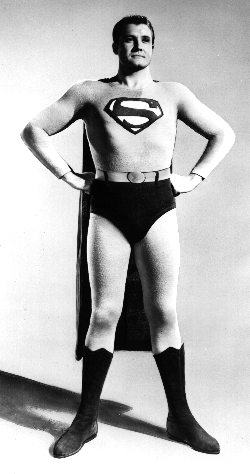
Today marks the anniversary of the death of George Reeves - the Superman of the 1950's TV show. He was found naked, face up on his bed at home with a gunshot wound, from a 9mm Luger, to the head. The death was ruled a suicide, and while there have been various theories about the "truth" of his death there has never been any concrete proof of wrongdoing. It seems likely he was a man immensly depressed and saw his career going nowhere outside of Superman.

And that got me thinking a little bit about the character of Superman.

The Last Son of Krypton is, of course, an icon. You'd be hard pressed to find someone who
doesn't know who Superman is. He's the first true superhero, ushering in the trend of crime-fighters in tights with fantastic powers that continues to this day. Created by Jerry Siegel and Joe Shuster back in 1932 (it was also the anniversary of the release of Action Comics #1 earlier in the week), Superman is many things to many people. For some, he is the ultimate outsider; the last survivor of a doomed planet. For others a farm raised boy-scout paragon of virtue, illuminating our potential. For others still he is an adolescent power fantasy wreaking havoc. Superman is all of these things, and more.

Having said that, I've never really been a fan. Sure, that S shield is known by everyone from here to Timbuktoo. The majority of his super-powers - strength, invulnerability, flight - are all the default for any new super-hero created. He even popularised wearin' your underpants on the outside. But he never really clicked for me (except for the undies on the outside thing. I did that). I think, and there's likely a lot of people who agree with me, he's too super. He's too perfect. When almost all other super-heroes have some sort of flaw, be it powered or character-wise, they're much easier to identify with.

What are Superman's weaknesses? Not many, that's for sure. He doesn't even have a sidekick people can mock and make suggestive references about. What about magic? Sure, why not? Kryptonite? Ahhhh, yes, kryptonite. It has permeated the public consciousness almost as much as the Man of Tomorrow himself. In fact, it may hold equal measure as Achilles heel in describing someone's weakness. But these are weaknesses introduced after the fact, specifically introduced so the character would have some sort of weakness.

But aside from those two, he cannot be harmed. The man can fly, move mountains, deflect bullets and rescue your kitten from a tree. Which, true, is what Siegel and Shuster were going for. They were two Jewish sci-fi geeks from Cleveland scrabbling around for a way into the funny books. Siegel's father had been shot and killed in a robbery years before, and the perpetrator never caught. It's not hard to see why their most famous creation can deflect bullets. But it makes it hard to relate to him. It's easier to identify with Peter Parker, where his costumed crime-fighting as Spider-Man caused him more grief than plaudits.

It will be interesting to see which interpretation Christopher Nolan "godfathers" the new Superman towards. He's apparantly interested in getting to the core of the character again; something I felt was missing from Bryan Singer's Superman Returns. His vision was too slavishly devoted to the Richard Donner originals (not too surprising I guess, as he worked with Richard Donner's wife Lauren Shuler Donner on two X-men movies) and hadn't realised the characters had moved on since then.

George Reeves, of course, was never "my" Superman. The Superman I knew was Christopher Reeve, all American boy-scout. Failing that it was George Newbern (voice actor in the Superman animated series and Justice League). I never picked up an issue of the book, I knew the character form other media and general pop-culture awareness. In fact, the first Superman comic I ever read was The Death of Superman back in the '90s. Killed by Doomsday, and not Lex Luthor?! What the hell was that?! There was no historical resonance with that. Just like kryptonite, Doomsday had been created merely as a way to kill Superman. And everyone knew that was a sales gimmmick; there was no way the Man of Steel would be gone for good. In fact I learned more about (and was subsequently more interested in) the character from the excellent Men of Tomorrow: Geeks, Gangsters and the Birth of the Comic Book by Gerard Jones, which details not only the creation and impact of Superman but all the events leading up to the creation of the comic book.

But hey. Here's to George, one of many to wear the tights. Superman is dead. Long live Superman. What are your thoughts on Kal-El/Clark Kent, the Man of Tomorrow and Last Son of Krypton?