Showing posts with label drama. Show all posts

April 18, 2012

Quick review: MARGARET (World Cinema Showcase)

Famously delayed, Kenneth Lonergan's Margaret makes it to NZ courtesy of the World Cinema Showcase, after an incredibly minimal release in the States.

Anna Paquin's Lisa Cohen and her reaction to witnessing and being part of deadly bus accident is the focus of this long-in-post film. It is the examination of a precocious and self involved teenager who is involved in an horrific and deadly accident - both as an observer and cause - and struggles to comprehend and move on from it; it is a film almost tangentially focussed on the aftermath of 9/11 in America and New York (filming as it did in 2005, just 4 years after those attacks).

The cast is one of outstanding quality. Paquin is given the opportunity to really do something special here and she grabs it with both hands and tears into it. Lisa Cohen is not an easy person to know, or even a very likeable one; she's in many ways a typical teenager arguing with her mother, flirting with the cute teacher and she carries a fierce intelligence, her speech often hyper-articulate. But she is, at heart, still a teenage girl more lost than she even knows. As she struggles with her own sense of guilt she throws herself into the lives of the accident victim's friends, berates the police and charges forward with a lawsuit in her struggle to accept and share the responsibility.

Surrounding her are Matt Damon, Jean Reno, Matthew Broderick and Mark Ruffalo. Though all of their parts, at least in this cut, are minimal they all make an impression. And doing impressive work as Lisa's mother and her mother substitute are J. Smith-Cameron and Jeannie Berlin. As the film is equally about Lisa and her mother and the woman who becomes something of a mother substitute for Lisa.
 It is a film of people talking; talking at and too one another, people yelling at one another, people arguing and being disappointed in one another. 

It is also a film about New York, with the camera often taking to wandering the skyline or watching the traffic passing on rain soaked streets. There is something almost Terrence Malick-like about the way Lonergan captures the city that never sleeps. There is beauty in the city, in addition to ominous images of air-planes and helicopters flying through or near the city.

It's a messy, shaggy, oblique and occasionally frustrating film. But then so is life and that's rather the point. Yes, you could lock Lonergan back in the editing room (or out) and cut a storyline here, cut a storyline there, nip & tuck a few things and make Margaret a stream-lined film about one thing and one thing only, but then that would really be taking away a large part of what makes Margaret special. It's flawed and one of those films that is kinda great because of those flaws. 

April 1, 2012

Reviews at the Speed o' Light: SHAME, MILDRED PIERCE, IT HAPPENED ONE NIGHT

This is first in what I assume will be an ongoing new feature here at rockets and robots are GO! With my primary focus for the year being my MA, I'm not going to have anywhere near the amount of time I would usually spend on writing up reviews for everything I see at the cinema. It's unfortunate, but the blog just cannot be my sole writing focus for the year. However, I am determined to keep this blog as something of an online journal of my cinematic viewings so, at the end of every month those films that I have yet to write up individually (usually retro or classic films) will be featured here.

To kick it off:
Poster design by Mark Carroll
Shame

British artist-turned-filmmaker Steve McQueen's Shame is a stark look at one man's addiction, the depths he sinks to and what it costs him. It doesn't pull punches and really doesn't shy away from showing anything and everything. And that is graphically shown in the first few minutes of the film with Michael Fassbender's Brandon wanders to and fro in his fancy apartment, absolutely starkers and yes, his cock in full view. 
But despite all of the nudity and the subject matter this is no erotic film. It is, in fact, entirely un-erotic, the sex and nudity being frank, matter-of-fact or entirely hollow and emotionless.

Brandon is a charming, well groomed and intelligent man with a job he seems to enjoy and is particularly good at. He has a nice enough apartment, no doubt expensive. He enjoys a drink with the lads. He is a sex addict. He picks up random women from bars or employs prostitutes. He spends his night's at home hollow-eyed and hunched over his laptop, surfing the internet for porn. He's not picky where he gets his fix from and, like most addicts, manages to keep it all secret from his boss and workmates.

This perfectly structured life of Brandon's is interrupted and thrown around by the arrival of his sister Cissy (Carey Mulligan), a singer who has decided to stay for an indefinite period of time. There is a lot of history between these characters hinted at, rather than spelled out. There is that sibling closeness, followed by Brandon blowing up at having to constantly "look after" Cissy.

McQueen allows scenes to run and run, the takes lingering and only cutting away when it becomes absolutely necessary. In this way, he allows the film to really get under your skin; to soak into you. The camera doesn't look away and, thus, neither can you. This long-take technique never becomes pretentious or allows itself to become a distraction to the viewer but instead is just another tool in McQueen's director's toolbox.

When you have a director who is using long-takes, it helps to people the film with actors who are really at the top of their game. Fassbender and Mulligan, two young British actors who have really broken out in the last couple of years, own the frames. Fassbender is an actor who projects and easy charm and charisma, as evidenced in Inglorious Basterds and as the globe totting Erik Lensherr in X-Men: First Class, and Shame is the first time I've witnessed that dark side he is capable of. 


Mildred Pierce
(Wellington Film Society screening)

The Film Society kicked off it's mini-season of noir films on 35mm with this Joan Crawford starring classic (recently remade with Kate Winslet in the title role). And thanks to the truly horrendous and spoilt daughter of the heroine, it was no less a difficult watch than Shame.

Mildred Pierce begins with a death. From there the story of how we reach that death is a tale told by Mildred to the cops. Mildred is a strong, independently-minded woman who has always wanted to do the best for her two daughters, especially eldest Veda. Poor Mildred is a woman used and abused by all the males close to her though; her cheating first husband, her close friend Wally and her lover/second husband Monte. They all use Mildred in different ways, the only half-way decent one being the cheating first husband Bert.

Michael Curtiz (Casablanca and the Errol Flynn starring The Adventures of Robin Hood) directs the screen legend as Mildred opens her own restaurant which becomes a flourishing chain. Veda sees the business as nothing more than money for her to buy things. This girl, this incomparable brat of a girl, is one of the most horribly selfish, materialistic and mean-spirited characters I've ever had the displeasure to witness. She truly cares not a whit for anyone or anything past herself and her own enjoyments. When Mildred finally whips round and slaps the hussy a well-deserved open right hand, I cheered.

A film that grips you rather than has you gripping the edge of your seat, the tale takes its twists and turns but is nowhere near as lurid (to modern eyes) as the advertising would have us believe. Instead Mildred is a strong woman in a man's world played by a strong woman in a man's world.

It Happened One Night
(Embassy Retro Showcase)

This is in fact the first Frank Capra film I've ever seen. Yup, including It's A Wonderful Life. Starring Claudette Colbert and Gone With the Wind's Clark Gable It Happened One Night puts modern romantic comedies to shame.

Colbert stars, luminously, as heiress Ellie who is, essentially, held under house(boat) arrest by her wealthy father. Actually, these opening moments, to modern eyes, give the feeling that this is going to be anything but a romantic comedy. More like a horrifying thriller.

But she escapes! Huzzah! Because she is in love with (and married to, though Daddy wants an annulment) Westley, who is in New York. Penniless but determined Ellie sets out from Florida to New York, travelling by bus. It is on the bus she bumps into Gable's drunken newspaperman, Peter Warne. He is a character of the age; an intelligent, charmingly drunk reporter of strong moral character(ish). He's a fast talker and a bit of a wise ass, though she's no slouch in that department either.

These two knock each other about cross-country, Warne looking out for the heiress who has little idea how the world works outside her sheltered life. And, surprise surprise, they find themselves falling in love. It's a light-hearted romp, with plenty of sparkling dialogue brought to life by two actors with a fine ear for it and actual chemistry together. 

March 22, 2012

Film review: THE IDES OF MARCH

It has taken me a little while longer than usual to come around to writing up George Clooney's latest directorial effort. Part of that is due to my scriptwriting MA and the increasing demands on my time. But an equal, or even larger, part is down to just being unsure what I made of The Ides of March.

Yes, the film is an intelligent, well acted and fairly involving peek behind the curtain of the world of politics (adapted from the play Farragut North by Beau Willimon). But beyond the film's obvious pedigree, I found myself feeling like something was not quite there; that the film hadn't completely enveloped me.

The world's current favourite heart-throb/internet meme Ryan Gosling is Stephen Myers, a young career campaigner who has managed to, somehow, maintain his idealism so far. The latest campaign he's working on is for George Clooney's Governor Mike Morris, running in the Democratic primary. Morris is the front-runner but his challenger is nipping at his heels; the contest isn't over yet. Morris has made a believer out of Myers - Morris is, essentially, the dream liberal politician and the man a lot people have pinned their hopes on.

That all changes when Myers agrees to a meeting with Paul Giamatti's Tom Duffy - the campaign manager for the other side. When Phillip Seymour Hoffman's campaign manager for Morris, Paul Zara, finds out he fires Myers. Myers, in the act of having his ego stroked and initially keeping it from Zara and Morris, finds his bright, fledgling career over. Not even Duffy will take him. The Ides of March is the story of the downfall of a, more or less, innocent man. How a good man can become a cold, calculating political animal. There's more to it, involving Evan Rachel Woods' smart, beautiful intern who Myers finds himself involved with

George Clooney's strength as a director lies in his unflashy presentation and ability to get out of the way of the material. He has, happily, moved on from the overt visual chicanery evidenced in his debut Confessions of a Dangerous Mind. He has built a library of obviously personal films and usually casts himself in a role that plays with his public persona; here as a Democratic candidate full of more Hope and Change than Obama and with the charm, charisma and intelligence of, well, George Clooney. But the film isn't the Clooney show - the role of Mike Morris is little more than an extended cameo with Gosling taking and owning the centre spotlight, while Giamatti, Hoffman and Marisa Tomei all do excellent work around him.

I cannot help but feel the story of Myers' descent would have been better served with a series; like a flipside to the optimism of The West Wing. An HBO mini-series would have allowed more room and time for the characters to really breathe. As it is, there are more than a couple sudden character reversals; one being a suicide that feels less like a real character decision and more like a plot device that was needed to get the story and characters into their required places. Very good, but falling just short of great. 
The Ides of March is a solid, intelligent and well-acted film that is not entirely remarkable. 

February 29, 2012

Film review: THE ARTIST

Is The Artist the "best" film from the last year, as the Oscars recently decreed? No. No its not. It is a surprise break-out hit from last year, garnering accolades and awards for its cast and writer/director as it played through festivals and limited releases.

By now, surely there are few people (reading this wee blog at least) that don't know about The Artist and the decision made for this film about the silent era in Hollywood to be almost entirely silent itself; as opposed to the classic and, frankly, better film about the transition from silent films to talkies, Singin' in the Rain. The Gene Kelly starring delight was in full colour, with toe-tapping songs, fun musical numbers and a star on the rise.

The Artist though is a black & white silent film about the downfall of a once-great silent era actor, George Valentin (Jean Dujardin). Valentin stubbornly refuses to do talkies and spirals further and further into obsolescence and depression. As he is on his way down, the charming young bit-player Peppy Miller (Bernice Berjo), who briefly crossed paths with Valentin is on her way up. She becomes the new toast of the town, captivating the studio bosses and audiences alike. Throughout her ascent she remembers Valentin and goes out of her way to help him in unobtrusive ways: buying up his possessions when they're up for auction, keeping an eye on him in the street. And, as you've probably heard, there is a dog.

The film is somewhat in line with director Michel Hazanavicius and Jean Dujardin's previous collaborations, OSS 117: Cairo, Nest of Spies and OSS 11: Lost in Rio. Both of those films were looking back to the aesthetics and style of a previous age of movies; in the case of the OSS 117 films the spy films of the 60's. They are goofy, self-referential, self-effacing and fun films. Dujardin is in similar form in The Artist, his big cheeseball movie-star grin lighting up and blasting through at a million watts.

However, I did begin to tire of Valentin's moping, that carries on past what is necessary. When he's at his absolute lowest, with his apartment and films burned to nothingness Valentin is taken in by Peppy Miller, the one person who still cares about him. She even still has all of things. But his idiotic pride continues, Hazanavicius continuing to have Valentin's foolish pride carry him through Hollywood.

There is a noticeable tension throughout the film; the modern tugging at the classic. The Artist uses the aesthetics but not the grammar of silent filmmaking. That is, the film is silent with characters mouthing their dialogue, with the occasional card informing us to what they're saying, but the film itself is shot in a resolutely modern cinematic style. Hazanavicius seems to show his interest lies more in the aesthetics (or gimmick if you're being cruel) than in veracity.

And, speaking of cruel, there has been a backlash amongst some critics against this surprise awards-gobbler. I come down on neither side. Whereas I believe Hugo more accurately and lovingly captures the silent filmmaking pioneers, The Artist is perfectly fine enough as a film from a filmmaker who set himself and his cast an ambitious goal. The conceit is intriguing, even if the story never fully held me. 

February 22, 2012

Film review: THE DESCENDANTS

Alexander Payne has been gone awhile after his award-winning Sideways. But thankfully, after an absence from cinema screens of 7 or so years he returns with George Clooney and Hawaii.

Clooney is Matt King, a lawyer whose family owns a large swathe of land on one of the islands. 
The films begins with King's wife Elizabeth recently in a coma, seemingly lifeless. King, the back-up parent, must struggle to re-connect and guide his two young daughters while at the same time deciding what to do with the family's land. The land is held in trust, with King the sole trustee. However, the laws governing ongoing trusts are due to change and King & the cousins must decide who to sell their large swathe of untouched Hawaiian land to. It's a fair amount for any one person to juggle, and things are given an extra frisson when it is revealed to King that Elizabeth, prior to her vegetable-like state, had been having an affair.

Payne gives us a view of Hawaii not generally seen on screen. Past the beach-set poster and beach-casual attire of everyone, the film opens on life in downtown. Hawaii has cities just like anywhere else in the States; people struggle, people suffer and people die. There is no surfing here; this is no holiday in Hawaii to forget Sarah Marshall.

Instead King struggles to remember; to remember what his marriage was and not what he wanted it to be, to be remember how to talk to his daughters, to remember why his family are trustees of virgin, undeveloped Hawaiian land. For all those highly-charged emotions, there is a breath of comedy (often dark) that winds its way through the film. It isn't there to put the audience at a distance, but instead serves to humanise the events and the characters

There is a noticeable thematic strand that runs through all of Payne's films so far, in way or another: that of males confronting their own mortality (and generally fairly weak or weak-willed men). Whether it's Matthew Broderick's high-school teacher attempting to overcome Reese Witherspoon's over-achieving class presidential contender; Jack Nicholson's recently retired Schmidt taking off on a road-trip after a lifetime of safe simplicity or Paul Giamatti and Thomas Haden Church carousing, drinking and navel-gazing around Californian vineyards. That continues, of course, in The Descendants with Clooney's King forced to confront the death of his marriage, and soon, the death of his wife.

There is not much here in the way of surprises, in that you are never really shocked by any character's reaction to an event or other character. But that is, in part, down to Payne's excellent character illustration and development; you find yourself unsurprised at their decisions because you get such a good feel for who these characters are. Clooney as the patriarch struggling to keep everything from his family to himself together has earned a number of critical plaudits already. And he is excellent, dialling down the usual "gorgeous George" charm to present someone smaller, a little broken. More human. Equally impressive is Shailene Woodley as King's eldest daughter, Alex. Alex is a slightly wayward teen, who has fought with her mother mainly because they are so similar. She has to help King with a lot of the heavy lifting, in looking out for youngest daughter Scottie and helping dad with tracking down the man who was sleeping with Elizabeth. There's a lot of conflicting emotions she has to deal with, a lot that has to be kept below the surface while she is outwardly outraged, and Woodley succeeds with the challenge.

The Descendants is a film I almost feel we're seeing less and less of: an intelligent, honest and relatable drama with imperfect, human characters. It can sometime seem we are bombarded with spectacle, whether it be blockbusters or awards-chasers, and so it is refreshing to have a film so seemingly intimate but with a lot to say. 

December 20, 2011

09.12: THE HELP

I know I'm coming to this film fairly late in the game, but it was one of the ones that got lost in the shuffle between the States and home. I was able to catch up with it thanks to the Penthouse Cinema's $8 "Oscar buzz" deal - films that are beginning to get some Oscar talk, playing twice a week for $8 a pop, a different film each week. I'm interested to see what else is coming up.

It's fairly obvious, but I'm just going to go ahead and state it upfront anyway: I am a white, middle-class male who grew up in New Zealand suburbia. I have never experienced racism first hand and my knowledge of 1960's America is limited to what I have learned from pop culture (my own historical proclivities tend towards the ancient). And through that (largely white male dominated) pop culture I have learned that minorities always need the help of a kindly white person to rise up and overthrow/stand up to the prevailing social hierarchy. Just look at the cinema of Ed Zwick who is the most recent purveyor of this kind of condescending film-making. Hollywood doesn't seem comfortable, or at least thinks audiences wouldn't be comfortable, with heroic minority lead characters. There's far more to be written (and has been) on the representation of African-Americans and Hispanics in American media and pop culture; far more than can be encapsulated within a movie review.

The Help is one of the least egregiousness examples of this type of filmmaking; the maid characters of Aibileen (Viola Davis) and Minny (Octavia Spencer) wrestle as much of the film away from the limp protagonist of Skeeter (Emma Stone) as they can, forcing the focus onto them by dint of their performances and stories.

Skeeter is a newly graduated journalism student, newly returned to Jackson, Mississippi and all hot and bothered to start writing something life changing and full of meaning. Instead, due to prevailing social attitudes of the time (and the fact that she is newly graduated with zero professional experience behind her) she is assigned the cleaning advice column of her hometown rag. Through needing cleaning advice of her own, Skeeter begins interviewing her friend's maid Aibileen. But she very quickly (immediately, essentially) uses the cleaning questions as a cover for interviewing Aibileen on what its really like to be a maid and raise white children, even at the cost of raising her own. These are the days of Jim Crow segregation and on the cusp of the Civil Rights movement; their interviews have to be in secret and, at first, Aibileen is the only woman willing to talk. There is the possibility of very real danger that is never fully exploited.

The only real danger and villain of the piece is the racist and bitchy Hilly (Bryce Dallas Howard), the queen bee of Skeeter's society circle. She is a deeply racist character, convinced of the lower nature of African-Americans and works to have separate outhouses for the maids installed in each house, to halt "their" diseases from spreading to whites. Hilly fires her longtime maid Minny when the woman dares to use the inside bathroom during a storm. Minny, all sass and with a large brood of children, ends up working for the socially shunned Celia (Jessica Chastain) and their times together actually provide some of the strongest moments in the film. Celia is a bundle of joyous nerves, with no idea of how to cook or maintain a household and with something of a white trash vibe about her. Despite, or perhaps because of this, she is more grateful than superior to Minny. It becomes a case of the maid trying to tell her mistress how things are supposed to run and, essentially, taking the woman under her wing. These two have a couple of powerful scenes between them and are more engaging than most.

It's a shame about the supposed lead character, Skeeter, then. Stone does her charismatic best to bring life to her, but crusading writer is barely more than a thinly sketched author surrogate. There's a mildly intriguing subplot with the mysterious firing of her family's much loved maid but a subplot with a boyfriend (all three scenes of it) are fairly forgettable and add nothing to the film but running time. This leaves the majority of the last half to stand with Aibileen and Minny; which is all for the better even if it initially feels uneven. Davis is powerful as the maid who gives all her love to the white children she raises and Spencer has deft comic timing in her role of the "sassy best friend" (and pie comeuppance giving) Minny. Howard and Chastain dive into their roles of villain and ditz with vigour. Howard seems to be enjoying the challenge of playing unsympathetic characters at the moment and it was a  joy to see Chastain with more to do than appear ethereal and angelic (Tree of Life).

But all this great character work by an ensemble of strong female actors is in service to a film that feels over-egged and dramatically limp. The entirety of this well-meaning drama made little emotional connection to me. It aimed for too much, perhaps, and felt a little forced at times. It is a decent enough film, I just felt that there was more to be discovered; harsher truths to be felt and a wider world to be seen. But then I am likely looking at the film through a different lens - this is no Malcolm X but a light, almost feel-good drama.

Fairly smart, if middlebrow and nonthreatening, expect to hear more from The Help around Oscar time. Especially when it comes to the acting nominations.

November 16, 2011

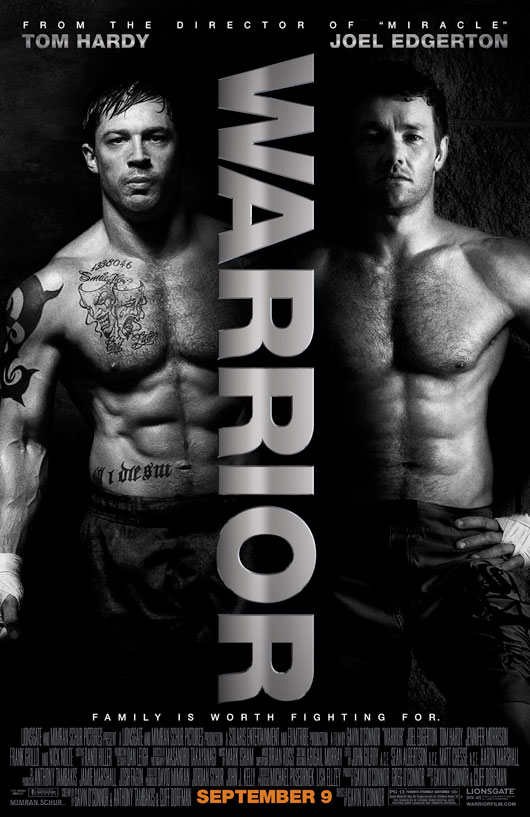
07.10: WARRIOR

Warrior: man on man action
One of those sports films I was talking about with Moneyball, Warrior is a film that unashamedly goes for the big emotions and grand gestures. It could almost be written off as a high gloss, high concept B-movie, but it's pulled off with such deft aplomb you cannot help but get sucked into the tale of familial melodrama.. and kickboxing.
Joel Edgerton and Tom Hardy are estranged brothers Brendan and Tommy. Their dad, played by Nick Nolte in full-on grizzled and haggard mode, is an ex-alcoholic and back in the bad old days, their mum left him. Tommy, a prize-winning wrestler trained by his dad, went with her while Brendan stayed with the old man. Brendan is now happily married with kids, a job teaching and money troubles that he tries to ease by fighting in car park mixed martial arts bouts. Tommy cared for their mother and watched her slowly die before joining the Marines. He washes up on his old man's doorstep. Neither brother has much to do anymore with the man responsible for so much pain in their lives - until Tommy washes up on his doorstep looking for a place to crash.

Both of these guys are fighters and both have very good reasons for needing money. Co-writer and director Gavin O'Connor is intent on giving the audience plenty of time with Tommy and Brendan, to really come to understand these two men and their motivations. It's possible too much time is given over to this set-up before O'Connor even reveals the pot o' gold at the centre of the film: a winner-takes-all mixed martial arts tournament with a massive cash prize.
Of course the two brothers are going to end up facing off in the cage in the final round. Everyone knows where the film is going, O'Connor just takes his time getting there. Yes, this allows the audience into the worlds of Tommy and Brendan but it begins to become frustrating when the tournament isn't even mentioned until a decent way into the film. But then, O'Connor has set himself a challenge by, essentially, attempting to give us two Rocky's in one movie. 

Joel Edgerton and Tom Hardy are two of the most interesting and physical actors working their way up Hollywood. Hardy of course has caught people's eyes with his transformation in Bronson and his scene stealing in Inception, while Edgerton made a big impression with little screentime in Animal Kingdom. They're both incredible presences and work to make their physicality as much a part of their characters. Hardy's Tommy is a hunched over bruiser, trying to hide his emotional bruising. As a fighter he's quick, vicious and brutal. He goes for the knockouts and doesn't stick around for the applause; he's only there to dish out the pain and win. Edgerton's Brendan though, stands tall; he has a solid base of family to support him and has worked through any demons he may have had. He's a battler, tenacious with his opponents. He doesn't give up, even against far bigger fighters.

And then between these two is the shambling presence of Nick Nolte, trying to do right by his boys but neither of them willing or able to forgive and forget his abuse. Nolte really knocks it out here - where Hardy internalises everything and lets that show through his physicality, Nolte cannot help but express everything. His Paddy Conlan is such a broken figure shuffling around his small house, hopeful for forgiveness but unsure he'll ever receive it.

Warrior is a big emotion sports movie - two underdogs, both equally compelling and both hungry for the prize. I know next to nothing about the world and sport of mixed martial arts, but then I don't need to. I'm not much for sports, but I do love sports movies. There's something about them, the way they're able to distill the visceral thrill of a game or a bout, with the emotional investment of a dedicated fan and Warrior does not disappoint. That final bout, the showdown between brothers, is what the film is all about and O'Connor ensures there's enough drama and tension to keep you invested. I think Warrior could comfortably play in a double-bill with Stallone's Rocky. 

November 4, 2011

01.10: 50/50

50/50 (formerly titled I'm With Cancer) is an emotional, hilarious and true story, based on screenwriter Will Reiser's time with cancer. Reiser wrote (and Rogen produced) 50/50 as there was the feeling that there was no "cancer film" that actually spoke to the experience of Reiser and his friends. Thus was born the dramatic comedy about cancer!

Joseph Gordon-Levitt is Adam, the Reiser stand-in while Reiser's real life friend Seth Rogen is Kyle, Adam's best friend and constant source of support. Instead of working as a writer on Da Ali G Show as Resier and Rogen were, Adam and Kyle work as writers in radio. Adam is something of a wet blanket/doormat - he's nice to a fault. He agonises over perfecting a radio segment on volcanoes, is a healthy neat-freak and is involved with the passive-aggressive artist Rachael (Bryce Dallas Howard) where he's the only one who offers anything to the relationship. Kyle is, on the surface, the typical "Seth Rogen type character" we've all come to know - loud, a little on the obnoxious side but with such charm and zeal he gets away with it. Kyle often comes off as a selfish jackass more concerned with getting laid but he's really just trying to keep things as normal as possible for his friend and being there in his own way. Rogen's energy, to me at least, works better as a support actor than the lead of a film.

The overall view of the "cancer experience" takes in a fair amount of territory - from Adam's workmates already thinking of him as dead to the counselling sessions with Anna Kendrick's kind and well-meaning but inexperienced Katherine. The relationship between Adam and Katherine was sadly one of the more obvious and under-developed but the two actors are just damned good enough to get you through it. Adam bonds with fellow cancer sufferers Matt Frewer and Phillip Baker Hall and fends off his over-protective mother, Anjelica Huston. His girlfriend, Rachael, is pretty much the worst girlfriend imaginable. Howard's character is given absolutely no redeeming qualities and is an all around shitty human-being, let alone a less than supportive partner. While it would have been preferable to see something good within her, to at least explain why Adam is with her in the first place, Howard is absolutely fearless with the role. She fully embraces the absolute crapiness of the character and goes with it for all she's worth.

There are emotional gutpunches that really hit home thanks to a combination of understated performance and a script that shies away from open manipulation. It's all coming from a place of honesty and experience; not the facts necessarily but the frightening reality of it. I don't think there's a person out there reading this who hasn't been touched by the dark spectre of cancer in someway. It is, of course, a very sensitive subject. Some might see the use of comedy as some sort of cheap trick but really, our lives are made up of parts comedy and drama every day. Why should this be any different? And the fact this is coming from a real, experienced place and that comedy can be marshaled to say something about us as humans just as much (if not more) as overly sentimental mush should get any thinking person past any reservations they might have. Reiser and director Jonathan Levine show no interest in being mawkish or obvious but rather give us something original, honest and intelligent. There's a balancing act in terms of tone here - a comedy about cancer?! C'mon, that's an almost impossible ask - either you go for gross, offensive comedy or overly emotional drama. What 50/50 does is give a perfect blending of the two - Reiser and Levine know when to go for the laughs and when to pull back and let the emotion hit you.

The ending can't really be spoiled can it? Reiser obviously survived his time with cancer because he was around to write the script, but 50/50 is a film more about the journey than the end destination (whatever that may be). It's not a perfect film but it is a very human film.